Buy phonetracker.eu ?
We are moving the project
phonetracker.eu .
Are you interested in purchasing the domain
phonetracker.eu ?
domain@kv-gmbh.de · 0541-91531010
Buy phonetracker.eu ?
Is integrating the opposite of differentiating?
No, integrating is not the opposite of differentiating. In mathematics, differentiation is the process of finding the derivative of a function, while integration is the process of finding the antiderivative of a function. These two processes are related, but they are not opposites. In fact, they are inverse operations of each other, meaning that integrating the derivative of a function will give you the original function. **
Why do constants disappear when differentiating?
Constants disappear when differentiating because the derivative of a constant is always zero. This is because a constant value does not change as the independent variable changes, so its rate of change is always zero. When taking the derivative of a function, the constant term does not affect the rate of change of the function, so it is essentially "ignored" in the differentiation process. **


Similar search terms for Differentiating
Top-Angebote
Products related to Differentiating:
-
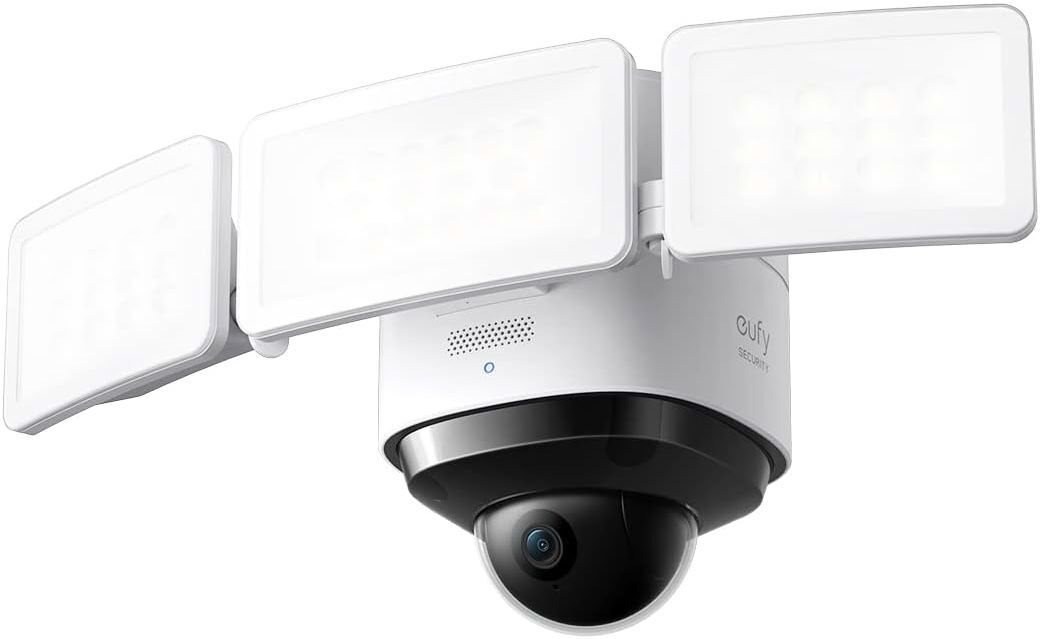
eufy Security Floodlight Cam S330 – 2K Ultra-HD 360-Degree Pan & Tilt Smart SurveillanceSecure your home with a perimeter defence system that leaves nowhere for intruders to hide. The eufy Security Floodlight Cam S330 (identified by EAN 0194644085445) is a sophisticated fusion of intelligent surveillance and high-intensity illumination. Engineered to eliminate the critical flaw of fixed-lens cameras—the blind spot—this professional-grade unit offers 360-degree situational awareness. By combining motorised motion with on-device AI, the S330 transforms your driveway, garden, or business frontage into a fully automated security hub that tracks threats in real-time. Key Features & Benefits Total Situational Awareness with 360-Degree Pan & Tilt: Effortlessly scan your entire property and eliminate hidden corners; the motorised lens allows for a full horizontal view, ensuring no movement goes unnoticed across your entire perimeter. Pro-Grade Clarity with 2K Full HD Resolution: Capture critical details with stunning precision; the high-resolution sensor provides the sharpness needed to identify facial features and vehicle details, providing actionable evidence when it matters most. Intelligent AI Subject Lock and Tracking: Stay one step ahead of intruders; the advanced on-device AI identifies human movement, locks onto the subject, and automatically pans to follow them, ensuring the target remains the centre of attention. Active Deterrence with 2,000-Lumen Dimmable Floodlights: Transform night into day; the motion-activated ultra-bright LEDs act as a powerful visual deterrent while providing full-colour night vision for unparalleled nocturnal surveillance. Zero Recurring Costs with Local Data Storage: Enjoy complete professional security with no monthly subscription fees; your footage is stored safely on-device, giving you total ownership of your data and significant long-term savings. Customisable Smart Detection Zones: Minimise frustrating false alarms; tailor the camera’s sensitivity and focus areas to ensure you only receive notifications for the movements that actually impact your security. Engineered for the Elements with Professional Weatherproofing: Designed to withstand the unpredictable UK climate, the robust housing ensures reliable performance through heavy rain, snow, and extreme temperatures. Why Choose This Product The eufy Security Floodlight Cam S330 (EAN 0194644085445)199,00 £*Shipping: 0,00 £Secure redirect to the provider
-
Seagate SkyHawk 1TB Surveillance Hard Drive 3.5" SATA 6Gb/s 64MB Cache for DVR NVR CCTV Security Systems ST1000VXZ05**Seagate SkyHawk 1TB Surveillance Hard Drive – ST1000VXZ05** Designed specifically for surveillance systems, the Seagate SkyHawk 1TB internal hard drive provides reliable storage for DVR, NVR and CCTV security camera systems. It is built for continuous recording and is suitable for home, business and professional security installations. ### Key Features * **Brand:** Seagate * **Series:** SkyHawk * **Model:** ST1000VXZ05 * **Capacity:** 1TB * **Form Factor:** 3.5-inch * **Interface:** SATA 6Gb/s * **Cache:** 64MB * **Type:** Surveillance / Video Hard Drive * Designed for **DVR, NVR and CCTV security systems** * Suitable for **24/7 surveillance recording** * Ideal for storing video footage from multiple security cameras * **3-year Rescue Services** included where applicable by Seagate * Suitable for home, office, retail and commercial surveillance applications ### Ideal For This hard drive is suitable for use with compatible: * CCTV systems * DVR recorders * NVR101,99 £*Shipping: 0,00 £Secure redirect to the provider
-
Uplift Essentials Health & Fitness Smart Ring Precision Sleep Tracking & Motion Monitoring black 11Professional Health & Fitness Smart Ring Precision Sleep Tracking & Motion MonitoringTake control of your wellness with the Professional Health & Fitness Smart Ring, a highperformance wearable wellness tracker designed for seamless integration into...85,97 $*Shipping: 0,00 $Secure redirect to the provider



-
Why does the constant disappear when differentiating?
The constant disappears when differentiating because the derivative represents the rate of change of a function at a specific point, and the constant does not affect this rate of change. When taking the derivative of a function, the constant term does not contribute to the slope of the function and therefore does not affect the derivative. As a result, the constant term is essentially a vertical shift and does not impact the slope or rate of change of the function. **
-
Why does the constant term disappear when differentiating?
The constant term disappears when differentiating because the derivative measures the rate of change of a function at a specific point. Since a constant term does not change as the input variable changes, its rate of change is zero. Therefore, when differentiating, the constant term does not contribute to the slope of the function and is thus eliminated from the derivative. **
-
What is the product rule for differentiating the exponential function?
The product rule for differentiating the exponential function states that if you have two functions, f(x) and g(x), and you want to find the derivative of their product, (f(x) * g(x)), you can do so by taking the derivative of the first function (f'(x)) multiplied by the second function (g(x)), plus the first function (f(x)) multiplied by the derivative of the second function (g'(x)). In the case of the exponential function, if you have two exponential functions, such as e^x and e^2x, their derivative would be e^x * 2e^2x + e^x * 2e^2x. **
-
Why can't exponents with the same base be added when differentiating?
Exponents with the same base cannot be added when differentiating because the rules of differentiation do not allow for the addition of exponents. When differentiating a function with exponents, the power rule states that the exponent is brought down and multiplied by the coefficient, but the exponents themselves are not added together. This is because the process of differentiation involves finding the rate of change of a function with respect to its variable, and adding exponents with the same base does not accurately represent this rate of change. Therefore, exponents with the same base cannot be added when differentiating. **


Why is it that when differentiating a polynomial function, one degree is always lost?
When differentiating a polynomial function, one degree is always lost because the power rule of differentiation states that when you differentiate a term with a variable raised to a power, you decrease the power by 1. Since the degree of a polynomial is determined by the highest power of the variable, each term in the polynomial will decrease in degree by 1 when differentiated. This results in the loss of one degree overall when differentiating the entire polynomial function. **
How can one use polynomial division to find f''(x) and f'(3x) when differentiating?
One can use polynomial division to find f''(x) by first finding f'(x) using polynomial division, and then differentiating f'(x) to find f''(x). To find f'(3x), one can first substitute 3x into the polynomial function to get a new polynomial in terms of x, and then use polynomial division to find the derivative of this new polynomial with respect to x. **
Top-Angebote
Products related to Differentiating:
-
Clever Finds Smart Watch Display With Health Monitoring And Sports Tracking Smart Watch Display With Health Monitoring And Sports TrackingExperience smarter days with a watch designed to keep you connected, active, and in control. This advanced smart watch features a vibrant 2.01 inch AMOLED HD display, 24H health tracking, and multiple fitness tools for everyday performance. Built...95,97 $*Shipping: 0,00 $Secure redirect to the provider
-
Everyday Crate SmartGuard Pet GPS Tracker Collar For Dogs & Cats With Waterproof Real Time Location Tracking redNever wonder where your furry companion has wandered again. This advanced pet GPS tracker helps pet parents stay connected to their dogs and cats with accurate realtime location monitoring and smart safety features. Designed for active pets and...74,97 $*Shipping: 0,00 $Secure redirect to the provider
-
eufy Security Floodlight Cam S330 – 2K Ultra-HD 360-Degree Pan & Tilt Smart SurveillanceSecure your home with a perimeter defence system that leaves nowhere for intruders to hide. The eufy Security Floodlight Cam S330 (identified by EAN 0194644085445) is a sophisticated fusion of intelligent surveillance and high-intensity illumination. Engineered to eliminate the critical flaw of fixed-lens cameras—the blind spot—this professional-grade unit offers 360-degree situational awareness. By combining motorised motion with on-device AI, the S330 transforms your driveway, garden, or business frontage into a fully automated security hub that tracks threats in real-time. Key Features & Benefits Total Situational Awareness with 360-Degree Pan & Tilt: Effortlessly scan your entire property and eliminate hidden corners; the motorised lens allows for a full horizontal view, ensuring no movement goes unnoticed across your entire perimeter. Pro-Grade Clarity with 2K Full HD Resolution: Capture critical details with stunning precision; the high-resolution sensor provides the sharpness needed to identify facial features and vehicle details, providing actionable evidence when it matters most. Intelligent AI Subject Lock and Tracking: Stay one step ahead of intruders; the advanced on-device AI identifies human movement, locks onto the subject, and automatically pans to follow them, ensuring the target remains the centre of attention. Active Deterrence with 2,000-Lumen Dimmable Floodlights: Transform night into day; the motion-activated ultra-bright LEDs act as a powerful visual deterrent while providing full-colour night vision for unparalleled nocturnal surveillance. Zero Recurring Costs with Local Data Storage: Enjoy complete professional security with no monthly subscription fees; your footage is stored safely on-device, giving you total ownership of your data and significant long-term savings. Customisable Smart Detection Zones: Minimise frustrating false alarms; tailor the camera’s sensitivity and focus areas to ensure you only receive notifications for the movements that actually impact your security. Engineered for the Elements with Professional Weatherproofing: Designed to withstand the unpredictable UK climate, the robust housing ensures reliable performance through heavy rain, snow, and extreme temperatures. Why Choose This Product The eufy Security Floodlight Cam S330 (EAN 0194644085445)199,00 £*Shipping: 0,00 £Secure redirect to the provider
-
Is integrating the opposite of differentiating?
No, integrating is not the opposite of differentiating. In mathematics, differentiation is the process of finding the derivative of a function, while integration is the process of finding the antiderivative of a function. These two processes are related, but they are not opposites. In fact, they are inverse operations of each other, meaning that integrating the derivative of a function will give you the original function. **
-
Why do constants disappear when differentiating?
Constants disappear when differentiating because the derivative of a constant is always zero. This is because a constant value does not change as the independent variable changes, so its rate of change is always zero. When taking the derivative of a function, the constant term does not affect the rate of change of the function, so it is essentially "ignored" in the differentiation process. **
-
Why does the constant disappear when differentiating?
The constant disappears when differentiating because the derivative represents the rate of change of a function at a specific point, and the constant does not affect this rate of change. When taking the derivative of a function, the constant term does not contribute to the slope of the function and therefore does not affect the derivative. As a result, the constant term is essentially a vertical shift and does not impact the slope or rate of change of the function. **
-
Why does the constant term disappear when differentiating?
The constant term disappears when differentiating because the derivative measures the rate of change of a function at a specific point. Since a constant term does not change as the input variable changes, its rate of change is zero. Therefore, when differentiating, the constant term does not contribute to the slope of the function and is thus eliminated from the derivative. **
Similar search terms for Differentiating
-
Seagate SkyHawk 1TB Surveillance Hard Drive 3.5" SATA 6Gb/s 64MB Cache for DVR NVR CCTV Security Systems ST1000VXZ05**Seagate SkyHawk 1TB Surveillance Hard Drive – ST1000VXZ05** Designed specifically for surveillance systems, the Seagate SkyHawk 1TB internal hard drive provides reliable storage for DVR, NVR and CCTV security camera systems. It is built for continuous recording and is suitable for home, business and professional security installations. ### Key Features * **Brand:** Seagate * **Series:** SkyHawk * **Model:** ST1000VXZ05 * **Capacity:** 1TB * **Form Factor:** 3.5-inch * **Interface:** SATA 6Gb/s * **Cache:** 64MB * **Type:** Surveillance / Video Hard Drive * Designed for **DVR, NVR and CCTV security systems** * Suitable for **24/7 surveillance recording** * Ideal for storing video footage from multiple security cameras * **3-year Rescue Services** included where applicable by Seagate * Suitable for home, office, retail and commercial surveillance applications ### Ideal For This hard drive is suitable for use with compatible: * CCTV systems * DVR recorders * NVR101,99 £*Shipping: 0,00 £Secure redirect to the provider
-
Uplift Essentials Health & Fitness Smart Ring Precision Sleep Tracking & Motion Monitoring black 11Professional Health & Fitness Smart Ring Precision Sleep Tracking & Motion MonitoringTake control of your wellness with the Professional Health & Fitness Smart Ring, a highperformance wearable wellness tracker designed for seamless integration into...85,97 $*Shipping: 0,00 $Secure redirect to the provider
-
Everyday Crate SmartGuard Pet GPS Tracker Collar For Dogs & Cats With Waterproof Real Time Location Tracking sky BlueNever wonder where your furry companion has wandered again. This advanced pet GPS tracker helps pet parents stay connected to their dogs and cats with accurate realtime location monitoring and smart safety features. Designed for active pets and...74,97 $*Shipping: 0,00 $Secure redirect to the provider
-
Uplift Essentials Health & Fitness Smart Ring Precision Sleep Tracking & Motion Monitoring black 9Professional Health & Fitness Smart Ring Precision Sleep Tracking & Motion MonitoringTake control of your wellness with the Professional Health & Fitness Smart Ring, a highperformance wearable wellness tracker designed for seamless integration into...85,97 $*Shipping: 0,00 $Secure redirect to the provider
-
What is the product rule for differentiating the exponential function?
The product rule for differentiating the exponential function states that if you have two functions, f(x) and g(x), and you want to find the derivative of their product, (f(x) * g(x)), you can do so by taking the derivative of the first function (f'(x)) multiplied by the second function (g(x)), plus the first function (f(x)) multiplied by the derivative of the second function (g'(x)). In the case of the exponential function, if you have two exponential functions, such as e^x and e^2x, their derivative would be e^x * 2e^2x + e^x * 2e^2x. **
-
Why can't exponents with the same base be added when differentiating?
Exponents with the same base cannot be added when differentiating because the rules of differentiation do not allow for the addition of exponents. When differentiating a function with exponents, the power rule states that the exponent is brought down and multiplied by the coefficient, but the exponents themselves are not added together. This is because the process of differentiation involves finding the rate of change of a function with respect to its variable, and adding exponents with the same base does not accurately represent this rate of change. Therefore, exponents with the same base cannot be added when differentiating. **
-
Why is it that when differentiating a polynomial function, one degree is always lost?
When differentiating a polynomial function, one degree is always lost because the power rule of differentiation states that when you differentiate a term with a variable raised to a power, you decrease the power by 1. Since the degree of a polynomial is determined by the highest power of the variable, each term in the polynomial will decrease in degree by 1 when differentiated. This results in the loss of one degree overall when differentiating the entire polynomial function. **
-
How can one use polynomial division to find f''(x) and f'(3x) when differentiating?
One can use polynomial division to find f''(x) by first finding f'(x) using polynomial division, and then differentiating f'(x) to find f''(x). To find f'(3x), one can first substitute 3x into the polynomial function to get a new polynomial in terms of x, and then use polynomial division to find the derivative of this new polynomial with respect to x. **
* All prices are inclusive of VAT and, if applicable, plus shipping costs. The offer information is based on the details provided by the respective shop and is updated through automated processes. Real-time updates do not occur, so deviations can occur in individual cases. ** Note: Parts of this content were created by AI.